
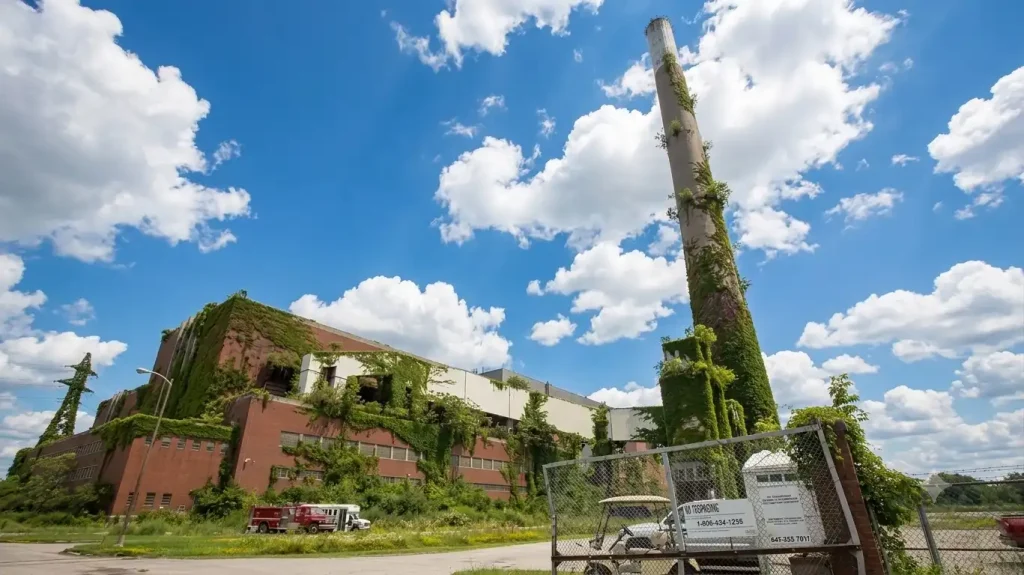
Looking southeast from my balcony, one landmark stands out: the massive Richard L. Hearn Generating Station. Built in 1951, as a response to soaring post-WWII demand for energy, the station boasted eight chimneys that spewed ash and smog into downtown Toronto and surrounding neighbourhoods. The environmental movement of the sixties demanded that the Hydro-Electric Power Commission of Ontario convert the fuel source to natural gas and replace the eight chimneys with one towering 215-metre (700 ft) concrete smokestack – the landmark I see today. In 1971, it was one of the tallest chimneys in the world. However, as nuclear energy and other green sources of electricity became available, the Hearn was less vital, and it was closed and decommissioned in 1983. There is an ongoing tug-of-war between the City of Toronto and developers over the Hearn’s future.
As is well known, our battles with pollution and climate change are far from over. Toronto’s transportation sector alone produces 5.7 megatons of greenhouse gases per year. Of that, 90% is produced by personal gasoline-powered vehicles which is the equivalent of burning 6.3 million litres of gasoline every 24 hours. Toronto has the lowest car ownership rate among major Canadian cities at 74% of residents owning a vehicle – the national average being 85%, yet 5.7 megatons of emissions per year remains very high by international standards.
We live in a society which perpetuates pollution and environmental degradation not just as a necessity, but as a lifestyle. Sure, there are solutions being developed as we speak, but can they come too soon? What’s to be said of animal suffering and factory farming? On a personal note, I’m a recent vegetarian so I’m not trying to preach but draw attention to the way society works. The 1973 story, “The Ones Who Walk Away From Omelas,” comes to mind. Can the suffering of the environment, other people or animals be enough to drastically rewrite how society functions?
One argument that has reared its head in different places online over the last few years concerns antinatalism. The argument says that antinatalists should “go live in isolation in the wild” since they do not approve of the multitude of births that keeps society running. Well, vegans and vegetarians don’t approve of the factory farming, but they benefit from living within society’s rules – a society that is still heavily reliant on meat products. This same principle applies to climate change – we all live in cities where we, indirectly or not, contribute to climate change. Should we go live in the forest off the land? You can repeat this with just about any moral infraction that society has to offer.
Asking someone to give up the life they’ve always known for a seemingly deranged pursuit of moral purity is impractical at least. Becoming vegetarian or vegan is a lifestyle change that’s manageable and accessible. Opting to take the TTC instead of driving is the same. We all need civilization to sustain ourselves even with its foibles. Sadly, it’s like being hooked on cigarettes. But better than having to adjust our lives in whichever way to minimize our destruction, it is better never to have been.
In closing, it’s worth it to point out that not procreating is a very practical and pragmatic thing to do. After all, 51.5% of Canadian women ages 20-49 have not given birth. That is a staggering number for something that sounds intuitively impossible. Furthermore, by not procreating, you spare the potential child a lifetime of suffering. On the misanthropic front, the potential child does not contribute to the ills of society. Requiring that existing people commit a metaphorical suicide by isolating themselves in the wild is not very pragmatic.
